
Damage Restoration in Oak Ridge, TN
- Damage Restoration Services Overview
- Common Damage Restoration Issues in Oak Ridge, Tennessee
- Neighborhoods We Serve in Oak Ridge
- Seasonal Damage Patterns in Oak Ridge
- Housing Characteristics & Restoration Considerations
- Environmental Conditions & Damage Implications
- The First 24 Hours: What Oak Ridge Property Owners Should Do After Damage Strikes
Damage Restoration Services Overview
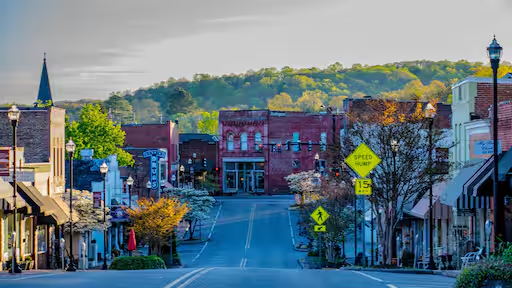
Oak Ridge was built in a hurry - much of the city rose from farmland in under three years during the 1940s Manhattan Project, and thousands of those original "Alphabet Houses" are still occupied today. That rapid wartime construction, combined with East Tennessee's humid climate and ridge-and-valley terrain, creates a unique set of restoration challenges for property owners across Anderson and Roane counties.
Restoration teams serving Oak Ridge handle a full spectrum of property emergencies:
- Water Damage Restoration - burst supply lines, failed water heaters, roof leaks, and appliance overflows
- Flooded Basement cleanup - groundwater intrusion, sump pump failure, and foundation seepage along sloped lots
- Sewage Cleanup - sewer backups, septic failures, and contaminated black water extraction
- Fire Damage Restoration - structural stabilization, debris removal, and content recovery
- Smoke Damage Restoration - soot removal, thermal fogging, and odor neutralization
- Mold Removal - containment, HEPA filtration, and antimicrobial treatment
Local providers including RestoPros of Knoxville, Southeast Restoration, and RestorePro Reconstruction answer emergency calls around the clock. Fast response matters: water migrates through subflooring within hours, and mold colonies can establish themselves in a day or two under Tennessee's summer humidity. Prompt professional drying, cleaning, and rebuilding protects both property value and indoor air quality.
Common Damage Restoration Issues in Oak Ridge, Tennessee
Oak Ridge sits in a valley between Black Oak Ridge and the Clinch River, and that topography channels stormwater straight toward homes on lower slopes.
Frequent Causes of Property Damage
- Heavy spring thunderstorms that overwhelm gutters, downspouts, and older storm drains
- Clinch River and Melton Hill Lake backwater during extended rain events
- Crawlspace moisture from clay soils that hold water against foundation walls
- Aging cast iron and clay sewer laterals in original wartime neighborhoods, prone to root intrusion and backups
- Winter pipe bursts when temperatures drop into the teens and uninsulated crawlspace lines freeze
- Kitchen and electrical fires in homes with original or partially updated wiring
- Wood stove and fireplace smoke damage during cold snaps
Warning Signs Oak Ridge Homeowners Should Watch For
- Musty odors in closets, crawlspaces, or along basement baseboards
- Cupped or discolored hardwood flooring near exterior walls
- Efflorescence - chalky white mineral deposits - on block foundation walls
- Slow drains or gurgling toilets, often the first hint of a sewer line problem
- Persistent smoke odor that returns on humid days after a small fire
- Visible staining on ceiling tiles, drywall seams, or around window headers
- Allergy or respiratory symptoms that improve when occupants leave the house
Catching these indicators early often means targeted drying or containment rather than full reconstruction.
Neighborhoods We Serve in Oak Ridge
Restoration crews respond throughout the city and into the surrounding Anderson and Roane county communities.
- Historic districts - Highland View, Woodland, East Village, and the original cemesto neighborhoods off Tennessee Avenue
- West Oak Ridge - Emory Valley, Westwood, Country Club Estates, and the Rarity Ridge area
- Central corridor - properties along Illinois Avenue, Oak Ridge Turnpike, and Jackson Square
- Lakefront and riverside - homes near Melton Hill Lake, Clinch River, and Solway
- Northern sections - Pine Ridge, Louisiana Avenue corridor, and neighborhoods bordering Black Oak Ridge
- Commercial zones - Horizon Center, the Oak Ridge Industrial Park, and Main Street retail properties
Service also extends to nearby Clinton, Karns, Farragut, Kingston, Harriman, and the western edge of Knoxville. Because response time drives outcomes, local dispatch keeps equipment staged close to Oak Ridge rather than routing trucks from distant hubs.
Seasonal Damage Patterns in Oak Ridge
Damage calls in Oak Ridge follow a predictable annual rhythm shaped by East Tennessee weather.
- December through February - Frozen and burst pipes lead the call volume. Space heater, fireplace, and wood stove incidents drive fire and smoke damage restoration work.
- March through May - Severe thunderstorm season brings roof leaks, flooded basement calls, and sewer backups when heavy rain infiltrates aging lines. Snowmelt combined with saturated clay soil pushes groundwater into crawlspaces.
- June through August - Humidity regularly exceeds 70 percent, making this peak mold removal season. Condensation on ductwork, undersized dehumidifiers, and unvented crawlspaces produce hidden colonies behind drywall.
- September through November - Remnants of Gulf tropical systems can dump several inches of rain in a day. Falling leaves clog gutters, redirecting water toward foundations. Furnace startups after months of idleness cause puffback and smoke damage.
Year-round, appliance failures - washing machine hoses, dishwashers, and water heaters - account for a steady share of emergency water extraction jobs regardless of season.
Housing Characteristics & Restoration Considerations
Oak Ridge's housing stock is older than the Tennessee average, with a large share of homes built between 1943 and 1960 and a second wave from the 1970s and 1980s.
Construction Types and Their Restoration Impact
- Cemesto panel homes - the original A through F house types use cement-asbestos board over fiberboard cores. These panels absorb water readily and require careful assessment; disturbing them during fire or water work may involve asbestos protocols.
- Vented crawlspace foundations - common across the city and a leading source of mold growth, wood rot, and elevated indoor humidity.
- Walkout and partial basements - found on sloped lots in Emory Valley and West Oak Ridge, frequently affected by hydrostatic pressure and seepage at the cold joint.
- Plaster and early drywall - older wall assemblies dry at different rates than modern gypsum, so drying plans must account for material density.
- Original galvanized or cast iron plumbing - corrosion and pinhole leaks cause slow, hidden water damage inside wall cavities.
- Knob-and-tube or early branch wiring remnants - a contributing factor in electrical fires in partially renovated properties.
What This Means for Restoration Work
- Moisture mapping with thermal imaging before demolition, since older assemblies hide water in unexpected paths
- Pre-work testing for asbestos and lead paint in pre-1980 structures
- Containment barriers to keep soot, sewage bacteria, or mold spores from spreading through open floor plans and shared crawlspaces
- Rebuild materials matched to historic profiles where homeowners want to preserve original character
Environmental Conditions & Damage Implications
Oak Ridge receives roughly 50 inches of rainfall annually - well above the national average - spread across a humid subtropical climate with mild winters and warm, sticky summers.
Local Environmental Factors
- Soil - shallow, clay-rich soils over karst limestone. Clay swells when wet, pressing against foundation walls; limestone below creates sinkholes and unpredictable drainage paths.
- Groundwater - high water tables in valley-floor neighborhoods keep crawlspace soil damp much of the year.
- Humidity - summer dew points frequently sit in the upper 60s and low 70s, which alone can sustain mold growth on organic building materials.
- Air quality - the Tennessee Valley's ridge topography traps particulates, and pollen loads in spring are heavy. After a fire, smoke odor lingers longer in these stagnant-air conditions.
- Water chemistry - moderately hard municipal water contributes to scale buildup and premature water heater and supply line failure.
How Conditions Shape Restoration Strategy
- Drying plans use dehumidification targets set for regional humidity, not generic national benchmarks
- Crawlspace encapsulation and vapor barriers are often recommended after repeat moisture events
- Sewage cleanup includes full antimicrobial treatment because warm, damp subfloors accelerate bacterial growth
- Smoke odor work relies on hydroxyl or ozone treatment plus source removal, since surface cleaning alone rarely holds in humid air
- Post-remediation verification testing confirms spore counts return to normal indoor levels
The First 24 Hours: What Oak Ridge Property Owners Should Do After Damage Strikes
The window immediately following a water intrusion, sewer backup, or fire determines how much of a property can be saved rather than replaced. Oak Ridge homeowners who act methodically in the first day typically face smaller rebuild scopes and cleaner insurance claims.
Immediate Steps
- Make the space safe. Shut off electricity to affected areas at the breaker. Leave the structure entirely if there has been fire, structural damage, or a strong odor of gas.
- Stop the source. Close the main water valve for plumbing failures. Do not attempt to clear a sewer backup yourself - black water carries pathogens that require protective equipment.
- Call a 24/7 restoration team. Providers such as RestoPros of Knoxville, Southeast Restoration at (877) 688-6050, and RestorePro Reconstruction at 984-370-9991 dispatch emergency crews at any hour.
- Document everything. Photograph and video every room, damaged item, and standing water line before anything is moved or extracted.
- Notify your insurer. Open the claim early and ask what documentation the adjuster will want.
- Protect undamaged belongings. Move furniture, electronics, and paperwork to a dry area if it is safe to do so.
What Not to Do
- Do not run household HVAC after a fire - it circulates soot through every duct in the house
- Do not wipe soot from walls with a damp cloth; it drives residue deeper into porous surfaces
- Do not use a shop vacuum on sewage water
- Do not disturb suspected mold growth without containment
- Do not discard damaged items before the adjuster or restoration technician documents them
What Happens When Crews Arrive
- Moisture mapping and thermal imaging to find hidden saturation
- Water extraction, controlled demolition, and placement of air movers and dehumidifiers
- Daily moisture readings until materials reach dry standard
- Cleaning, deodorizing, antimicrobial application, and reconstruction to pre-loss condition
Oak Ridge crews carry local ratings in the 4.7 to 4.8 range for fire, smoke, water, and dry rot repair work - a reflection of consistent response and thorough follow-through.





