
Damage Restoration in Huntertown, IN
- Damage Restoration Services Overview
- Common Damage Restoration Issues in Huntertown, Indiana
- Neighborhoods We Serve in Huntertown
- Seasonal Damage Patterns in Huntertown
- Housing Characteristics & Restoration Considerations
- Environmental Conditions & Damage Implications
- Sump Pumps, Septic Systems, and Basement Protection in Huntertown
Damage Restoration Services Overview
You come home from work on a February evening in Huntertown, open the basement door, and hear water running where no water should be. A supply line behind the utility sink split, and two inches of water now cover the floor, the storage totes, and the carpet padding in the finished half of the basement. What happens in the next few hours determines whether this becomes a drying job or a rebuild.
Water Out handles the full range of property damage emergencies for Huntertown homeowners and business owners, with 24/7 emergency response across Allen County and northeast Indiana.
- Water Damage Restoration - burst pipes, appliance failures, roof leaks, and storm intrusion, with hidden moisture mapping and controlled structural drying.
- Flooded Basement Cleanup - extraction of standing water, removal of saturated materials, and drying of block and poured foundation walls.
- Sewage Cleanup - safe removal of contaminated water from backed-up floor drains, failed ejector pumps, and septic system overflows.
- Fire Damage Restoration - structural cleaning, debris removal, content handling, and repairs room by room.
- Smoke Damage Restoration - soot removal from surfaces and HVAC systems, plus odor treatment that reaches porous materials.
- Mold Removal - containment, source correction, and remediation of affected building materials.
Every job starts the same way: a clear explanation of what happened, what it will take to fix, and what your options are.
Common Damage Restoration Issues in Huntertown, Indiana
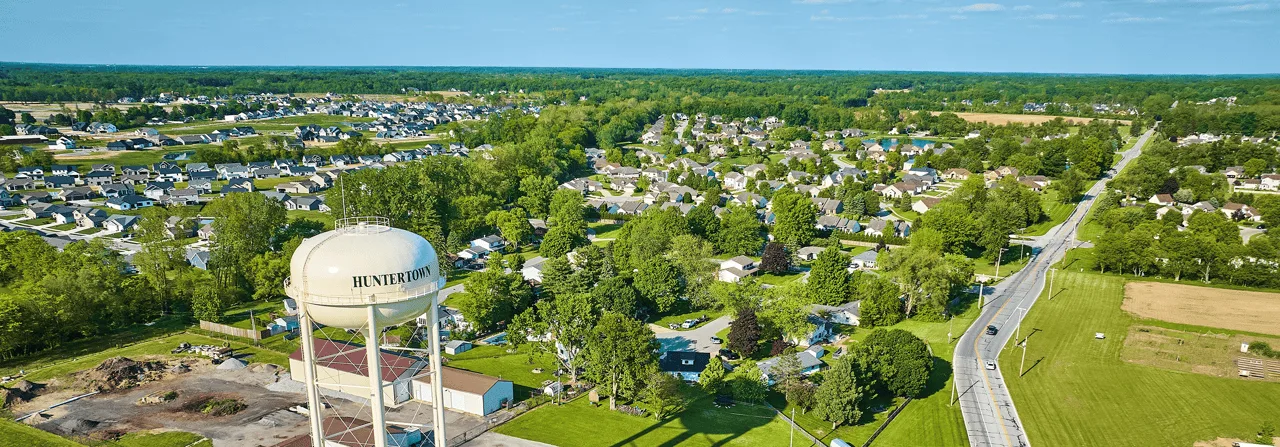
Huntertown sits north of Fort Wayne in a landscape of flat farm ground, clay-heavy soil, and slow-draining swales. That combination sends water toward foundations rather than away from them.
What Causes Most Local Losses
- Groundwater pressure on basement walls - saturated clay holds moisture against block, pushing water through cove joints and hairline cracks.
- Sump pump failure - power outages during summer storms leave pits overwhelmed within an hour.
- Frozen and burst pipes - lines running through unheated crawl spaces, garages, and rim joists split during January cold snaps.
- Sanitary and septic backups - older county septic fields and municipal line surcharges during heavy rain push waste water back through floor drains.
- Heating and cooking fires - wood stoves, space heaters, and kitchen incidents concentrate in the colder months.
- Roof and window leaks - wind-driven rain and ice dams work into attic insulation and wall cavities.
Warning Signs Worth Acting On
- Musty odor in the basement or lower level that returns after ventilation
- Efflorescence, chalky white residue, or peeling paint on foundation walls
- Cupping or darkening at the edges of hardwood flooring
- Staining on ceiling drywall near bath fans and roof valleys
- Gurgling floor drains or slow fixtures after rainfall
- Lingering smoke smell that intensifies when the furnace or AC runs
Small signals rarely stay small. Moisture trapped inside wall cavities can support mold growth in a matter of days once temperatures rise.
Neighborhoods We Serve in Huntertown
Our crews cover the town limits and the surrounding rural stretches of Perry and Eel River townships.
- Downtown Huntertown along Lima Road and the Main Street corridor
- Newer subdivisions near Carroll Road, Gump Road, and Hathaway Road
- Acreage properties and country homes along Cook Road, Shoaff Road, and Coldwater Road
- Areas bordering Cedar Canyons Road and the Cedar Creek watershed
- Adjacent communities including Wallen, Arcola, Leo-Cedarville, and north Fort Wayne
Beyond Huntertown, we regularly respond in Fort Wayne, Auburn, Angola, Kendallville, Ligonier, Waterloo, Albion, Harlan, Butler, Columbia City, South Whitley, Roanoke, Ossian, Hoagland, New Haven, Woodburn, Yoder, Zanesville, and Poe. Whether the address is a subdivision home minutes from Carroll High School or a farmhouse on a gravel road, dispatch works the same way - fast arrival and honest communication from the first phone call.
Seasonal Damage Patterns in Huntertown
Winter (December - February)
- Frozen pipe breaks in crawl spaces, exterior walls, and unheated garages
- Ice dams forcing meltwater under shingles and into ceilings
- Peak season for furnace, fireplace, and space heater fires, followed by widespread smoke damage
Spring (March - May)
- Snowmelt combined with heavy rain saturating clay soils
- Flooded basements and overwhelmed sump systems
- Sewage backups when storm volume surcharges lines and septic fields
Summer (June - August)
- Severe thunderstorms, hail, and straight-line winds opening roofs and windows
- Power outages disabling sump pumps during the worst downpours
- Mold growth accelerating in humid basements and closed-up crawl spaces
- Lightning strikes and grill fires
Fall (September - November)
- Clogged gutters and downspouts diverting water against foundations
- First furnace runs pushing dormant dust, soot, and mold spores through ductwork
- Ideal window for moisture inspections before freezing weather arrives
Housing Characteristics & Restoration Considerations
Huntertown's housing stock splits into distinct groups, and each one fails in its own way.
Century Farmhouses and Older Town Homes
- Fieldstone or unreinforced block foundations that seep at the base of walls
- Plaster and lath that holds water far longer than drywall and requires slower, monitored drying
- Balloon framing that lets smoke and fire travel vertically between floors
- Possible asbestos-containing materials and lead paint requiring careful handling
1970s - 1990s Ranches and Split-Levels
- Poured or block basements with perimeter drain tile nearing the end of its service life
- Original cast iron or clay sewer laterals prone to root intrusion and backups
- Finished lower levels with carpet, paneling, and studs sitting directly on concrete
- Fiberglass batt insulation that mats and holds moisture after flooding
Newer Subdivision Construction
- Tight building envelopes that trap humidity when ventilation fails
- Second-floor laundry rooms and refrigerator ice lines that leak into ceilings below
- Engineered wood flooring and MDF trim that swells quickly and rarely dries flat
- Deep basements and egress window wells that collect runoff
Restoration plans account for these differences. Drying a plaster wall in a 1910 farmhouse takes a different equipment layout and timeline than drying a modern basement with a vapor barrier behind the drywall, and mold remediation in a tightly sealed home demands containment that protects the rest of the living space.
Environmental Conditions & Damage Implications
Climate and Humidity
Northeast Indiana runs roughly 36 to 40 inches of precipitation annually with humid summers and freeze-thaw winters. Summer dew points regularly climb into the upper 60s, which means outside air alone will not dry a wet basement - it adds moisture. Controlled drying with dehumidification and air movement is the only reliable path.
- Indoor relative humidity above 60 percent supports mold colonization
- Repeated freeze-thaw cycles widen foundation cracks year after year
- Cool basement surfaces condense warm summer air, wetting stored contents
Soil and Groundwater
- Glacial till and clay-rich soils drain slowly and hold water against foundations
- Flat terrain near Cedar Creek and Willow Creek leaves standing water in yards after storms
- High seasonal water tables raise hydrostatic pressure under basement slabs
- Expansive clay shifts with moisture swings, stressing walls and floor joints
Water and Air Quality
- Hard, mineral-rich water in rural wells shortens the life of water heaters and supply connections
- Well and septic systems on acreage properties raise contamination stakes during backups
- Agricultural dust and pollen load HVAC filters, compounding smoke odor after a fire
- Soot particles bond with humid air and settle deeper into porous surfaces
These conditions shape our approach - moisture readings taken inside wall cavities, antimicrobial application where contamination is present, and verification that materials reach dry standard before reconstruction begins.
Sump Pumps, Septic Systems, and Basement Protection in Huntertown
Nearly every basement loss we respond to in the Huntertown area traces back to one of three points of failure: the sump system, the sewer or septic connection, or the grade around the house. Understanding those three gives homeowners real leverage.
Sump System Realities
- Test the pump quarterly by pouring a bucket of water into the pit and confirming the float rises and the pump cycles.
- Verify the discharge line runs well away from the foundation and does not terminate where it recirculates back to the drain tile.
- Check the discharge outlet each fall for crushed pipe, ice, or mulch blockage.
- Install a battery backup or water-powered secondary pump - summer storms take out power exactly when the pump matters most.
- Replace primary pumps proactively rather than waiting for the failure that floods a finished lower level.
Sewage and Septic Cautions
- Category 3 water carries bacteria and viruses - keep people and pets out of the affected area
- Porous materials touched by sewage, including carpet, pad, and drywall, generally cannot be salvaged
- Backwater valves reduce risk for homes with basement fixtures below street grade
- Rural septic fields saturated by spring rain lose capacity and push waste back indoors
- Professional cleanup includes contaminated material removal, hard surface sanitizing, and drying with containment
What Happens When You Call
- We assess the property and identify the water source and category.
- We explain the extent of damage and the restoration plan so you can make an informed decision.
- We use moisture meters and thermal imaging to find hidden saturation, then extract standing water.
- We set drying equipment, monitor daily, and document readings throughout the process.
- We address mold risk, odor, and repairs so the space returns to pre-loss condition.
Documentation matters when insurance is involved, and we keep records from the first reading to the final dry standard verification.





