Damage Restoration in Linn County, IA
- Damage Restoration Services Overview
- Common Damage Restoration Issues in Linn County, Iowa
- Neighborhoods We Serve in Linn County
- Seasonal Damage Patterns in Linn County
- Housing Characteristics & Restoration Considerations
- Environmental Conditions & Damage Implications
- Post-Flood Mold Risk in Cedar River Corridor Basements
Damage Restoration Services Overview

Finding water spreading across a finished basement floor - or walking into a home filled with smoke odor after a kitchen fire - throws everything off balance. Property damage in Linn County rarely arrives at a convenient hour, and the decisions that follow feel heavy when you are standing in the middle of it.
Restoration work exists to take that weight off your shoulders. Trained technicians handle the extraction, drying, cleaning, and rebuilding while you focus on your family and your insurance paperwork.
- Water Damage Restoration - extraction, structural drying, and moisture verification after pipe breaks, appliance failures, roof leaks, and river flooding.
- Flooded Basement Cleanup - pump-out, content triage, and drying of below-grade spaces where groundwater and sump failures collect.
- Sewage Cleanup - containment and disinfection of Category 3 contamination from backed-up floor drains and lateral line failures.
- Fire Damage Restoration - stabilization, debris removal, soot cleaning, and full reconstruction of framing, drywall, and finishes.
- Smoke Damage Restoration - odor neutralization, HVAC cleaning, and treatment of surfaces that absorbed smoke residue.
- Mold Removal - containment, controlled removal of affected materials, and correction of the moisture source feeding the growth.
Because these losses overlap - a flooded basement often becomes a mold problem, and a fire always becomes a water problem - working with one team that handles all six keeps the process moving.
Common Damage Restoration Issues in Linn County, Iowa
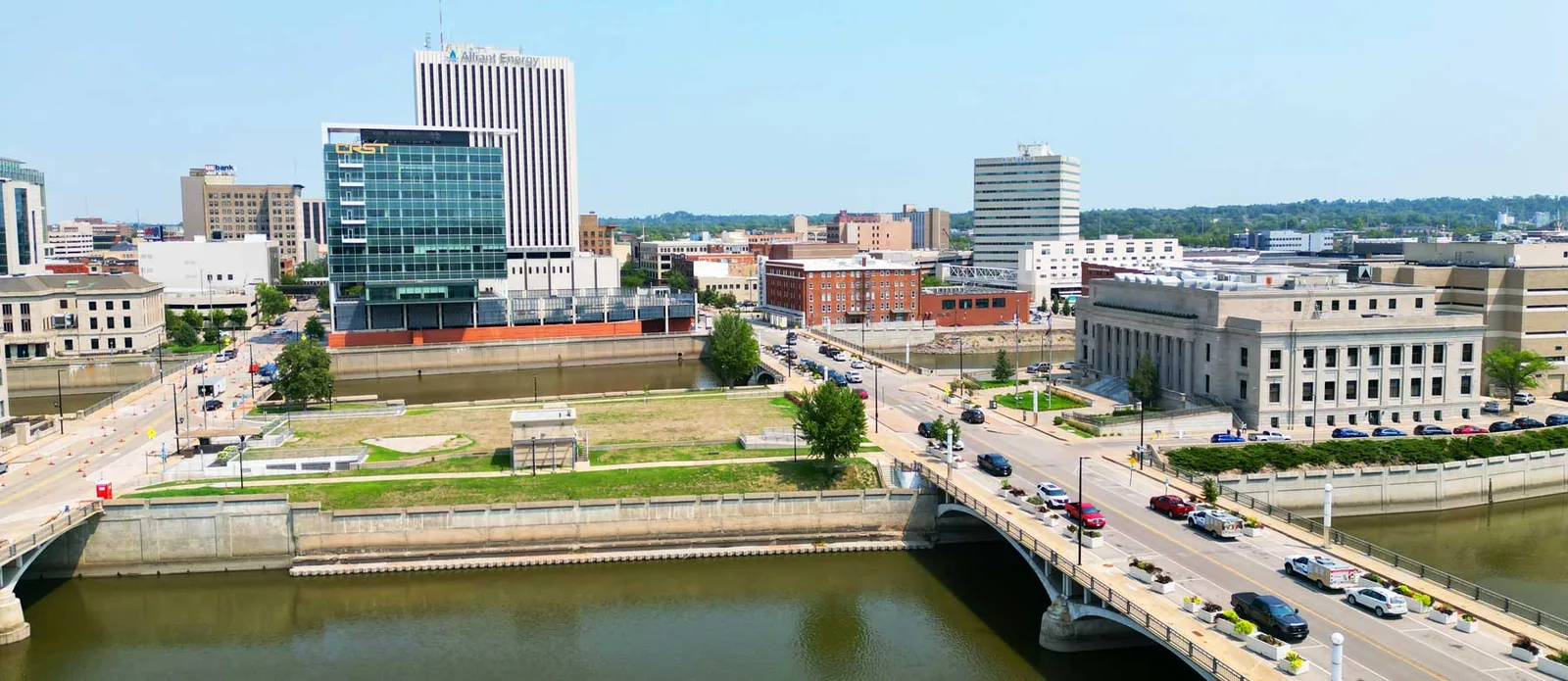
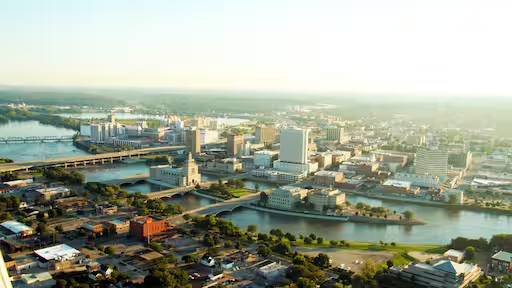
The Cedar River defines Cedar Rapids. The city grew on both banks, and the river's flooding history shapes the water damage risk profile of the entire Linn County corridor through Marion, Hiawatha, and Palo.
Spring precipitation and snowmelt cycles push the river up with recurring regularity. Upstream runoff from agricultural ground compounds the volume, and homes near the banks see direct river intrusion into lower levels.
Damage Sources Seen Most Often Here
- River flooding and flash saturation affecting basements and crawl spaces
- Sump pump failures during extended power outages in storm season
- Frozen and burst supply lines in unheated basements and exterior walls
- Sanitary sewer backups when heavy rain overwhelms municipal capacity
- Cooking fires, chimney and wood stove fires, and electrical faults in older wiring
- Derecho-style wind events opening roofs and letting rain into attics and ceilings
Warning Signs Worth Acting On
- Musty or earthy odor in a basement that smells stronger after rain
- Paneling, drywall, or baseboard that feels soft, cool, or bubbled near the floor
- Efflorescence - white chalky residue - on foundation block or poured walls
- Floor drains that gurgle or drain slowly during storms
- Smoke odor that returns on humid days weeks after a fire
- Rust staining at the base of metal furniture legs or appliance feet
Properties that flooded in past river events and were dried informally often carry active growth inside wall cavities and subfloor framing - hidden behind finished surfaces and still progressing.
Neighborhoods We Serve in Linn County
Coverage spans the full county and the surrounding eastern Iowa communities that share the same river and weather patterns.
- Cedar Rapids - Czech Village, NewBo, Kenwood Park, Wellington Heights, Time Check, Ellis, Mound View, and the northeast and southwest quadrants
- Marion and Robins - established neighborhoods plus newer subdivisions north of Highway 151
- Hiawatha, Toddville, and Springville
- Palo, Fairfax, Atkins, Walford, and Ely
- Mount Vernon, Lisbon, Martelle, and Central City
Service also reaches north toward Vinton, Urbana, Shellsburg, Waterloo, and Evansdale; south through Solon, Swisher, North Liberty, Tiffin, Coralville, and Iowa City; and east into the agricultural communities of Jones, Cedar, and Benton counties. Rural acreages on private wells and septic systems receive the same attention as in-town properties.
Seasonal Damage Patterns in Linn County
Each season brings a different call pattern across eastern Iowa.
- December through February - frozen pipe breaks dominate. Supply lines in rim joists, crawl spaces, and vacant properties split during deep cold snaps, then release water when temperatures rebound. Heating equipment and fireplace use drive fire and smoke losses.
- March through May - snowmelt combines with spring rain to raise the Cedar River and saturate soils. Flooded basements, seepage through foundation cracks, and sump pump overload peak now.
- June through August - thunderstorms, straight-line winds, and hail open roofs. Sewer backups follow intense downpours. Warm, humid air makes mold growth in damp basement framing move quickly.
- September through November - falling temperatures push condensation into cool basements and crawl spaces. Hidden summer moisture surfaces as odor. Furnace startup circulates settled smoke and dust and reveals earlier damage.
Two windows deserve extra attention: the weeks right after spring high water, when drying is still possible before growth establishes, and the first hard freeze, when unprotected plumbing is most exposed.
Housing Characteristics & Restoration Considerations
Linn County housing spans more than a century of building practice, and each era responds differently to water, smoke, and mold.
Common Construction Types
- Pre-1940 homes in Czech Village, Wellington Heights, and older Marion blocks - stone or brick foundations, plaster over wood lath, balloon framing, and knob-and-tube remnants
- Post-war ranches and Cape Cods - poured or block foundations with finished basements added later, often with paneling and carpet directly on concrete
- 1970s through 1990s split-levels and two-stories - lower levels partially below grade, drywall to the floor, and fiberglass batt in framed basement walls
- Recent subdivisions in Robins, Hiawatha, and Fairfax - tighter envelopes, engineered lumber, and egress-equipped finished lower levels
How Age Shapes the Work
- Balloon framing lets smoke and fire travel vertically through wall cavities - inspection extends well beyond the visible burn area.
- Plaster holds moisture longer than drywall and needs different drying targets and monitoring.
- Basement wall assemblies built directly against block trap water behind vapor-tight finishes, which is where post-flood mold most often develops.
- Older homes may contain asbestos-bearing floor tile, mastic, or pipe wrap and lead-based paint, requiring testing before demolition.
- Engineered joists and OSB subfloor in newer builds lose strength faster when saturated, so early extraction matters more.
Documentation of material type, moisture readings, and removal decisions supports the insurance claim and gives you a clear record of what was done.
Environmental Conditions & Damage Implications
Eastern Iowa's climate swings hard - humid continental summers and cold, dry winters - and that range drives most of what restoration crews see.
Climate and Moisture
- Summer dew points regularly climb into the upper 60s and low 70s, so outside air alone cannot dry a basement - it adds moisture.
- Winter indoor humidity drops sharply, which is why smoke odor and mold can go quiet for months and return with warm weather.
- Annual precipitation concentrates in spring and early summer, matching peak river stage and saturated soil conditions.
Soil and Groundwater
- Glacial till and alluvial river-bottom soils near the Cedar hold water and transmit it laterally toward foundations.
- Heavy clay content produces slow percolation, hydrostatic pressure against basement walls, and seepage at cove joints.
- Elevated water tables after river crests keep sump systems running continuously and expose pump failures.
Water Quality and Air
- Floodwater from the river and from sewer backups is contaminated - agricultural runoff, fuel, and sanitary waste make it a Category 3 loss requiring disinfection, not just drying.
- Rural properties on private wells need water testing after flooding before the supply is used again.
- Agricultural dust, seasonal pollen, and smoke particulate all load HVAC systems, so duct cleaning is often part of fire and smoke recovery.
Controlled drying with dehumidification and containment - rather than open windows and fans - is what produces verified dry structure in this climate.
Post-Flood Mold Risk in Cedar River Corridor Basements
Many Linn County homes that took on water during past river events were cleaned up quickly and informally. Carpet came out, fans ran for a weekend, and the space looked fine.
The problem sits behind the finished surface. Water wicks up drywall, soaks bottom plates and fiberglass insulation, and settles in the gap between framing and block. Nothing about that assembly dries on its own, and Iowa's humid summers keep it active.
What a Proper Assessment Involves
- A walkthrough covering the full lower level, mechanical room, and rim joist - not just the area you pointed out.
- Moisture meter and thermal imaging readings taken at multiple heights on each wall and logged by location.
- Small inspection openings in suspect wall cavities to see framing, insulation, and the back of the drywall.
- A written scope showing which materials come out, what gets cleaned and dried in place, and why.
- Containment and negative air setup before any removal begins, so spores stay out of the rest of the house.
- Post-work verification readings and photo documentation you receive in writing.
Questions You Should Always Get Answered
- What is the moisture source, and how is it being corrected?
- Which materials are salvageable and which are not?
- How will drying progress be measured and reported to me?
- What does the reconstruction phase include - framing, drywall, trim, flooring?
- What documentation goes to my insurance carrier?
Clear answers up front prevent surprises later. Contents are separated, protected, and stored while work proceeds, and a single team carrying the job from mitigation through rebuild means no gap where the property sits half-finished waiting on another contractor.