
Damage Restoration in Hiawatha, IA
- Damage Restoration Services Overview
- Common Damage Restoration Issues in Hiawatha, Iowa
- Neighborhoods We Serve in Hiawatha
- Seasonal Damage Patterns in Hiawatha
- Housing Characteristics & Restoration Considerations
- Environmental Conditions & Damage Implications
- IICRC Standards and the Hiawatha Restoration Process
Damage Restoration Services Overview
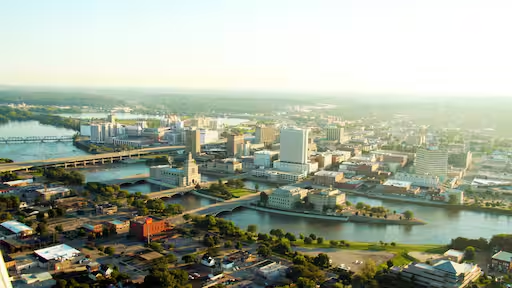
Hiawatha sits just north of Cedar Rapids in Linn County, where flat terrain, clay-heavy soil, and a mix of 1970s ranch homes and newer subdivisions create a specific set of restoration challenges. Sump pump failures, frozen supply lines, and sewer backups drive a large share of local emergency calls.
Restoration here means more than drying a carpet. It means finding trapped moisture inside wall cavities, under subfloors, and behind finished basement framing before mold takes hold.
- Water Damage Restoration - extraction, structural drying, moisture mapping, and monitoring until materials return to dry standard.
- Flooded Basement Cleanup - pump-outs after sump failures, sprinkler breaks, and storm water intrusion, plus removal of saturated pad, drywall, and insulation.
- Sewage Cleanup - contained removal of Category 3 water, disposal of porous materials, and antimicrobial treatment of affected surfaces.
- Fire Damage Restoration - board-up, debris removal, soot cleaning, contents handling, and full reconstruction when needed.
- Smoke Damage Restoration - odor neutralization, HVAC cleaning, and treatment of residues that travel far beyond the burn area.
- Mold Removal - containment, negative air, safe removal of colonized materials, and correction of the moisture source.
Local crews typically reach Hiawatha addresses within roughly an hour, which limits secondary damage and keeps more of your building materials salvageable.
Common Damage Restoration Issues in Hiawatha, Iowa
Most Hiawatha losses trace back to a handful of repeat offenders. Knowing them helps homeowners catch problems early.
Frequent Causes of Loss
- Sump pump failure - burned-out motors, stuck floats, or power outages during heavy spring storms.
- Frozen and burst pipes - lines running through uninsulated crawl spaces, garages, and exterior walls during January and February cold snaps.
- Sprinkler and supply line breaks - common in commercial buildings along Boyson Road and North Center Point Road.
- Sewer backups - saturated municipal lines and older lateral pipes pushing waste into floor drains.
- Water heater and appliance failures - slow leaks behind washers, dishwashers, and refrigerator ice lines.
- Kitchen and electrical fires - cooking incidents and aging wiring in mid-century homes.
Warning Signs Worth Acting On
- Musty odor in the basement that gets stronger after rain.
- Efflorescence - white chalky residue - on foundation walls.
- Buckling laminate, cupping hardwood, or soft spots underfoot.
- Tape seams lifting or drywall staining near the floor line.
- Sump pit that stays full or a pump that cycles constantly.
- Lingering smoke odor that returns when the furnace runs.
- Recurring allergy symptoms that ease when you leave the house.
Mold can begin colonizing damp organic materials within a day or two, so a small unnoticed leak in a finished basement can turn into a containment job quickly.
Neighborhoods We Serve in Hiawatha
Service covers all of Hiawatha and the surrounding Linn County corridor, including residential streets near Guthridge Park, the Tower Terrace Road corridor, Emmons Street neighborhoods, Boyson Road commercial properties, and the newer subdivisions along the city's north and west edges.
Crews also respond throughout the wider Cedar Rapids metro and eastern Iowa region:
- Marion, Robins, Toddville, and Palo
- Cedar Rapids, Fairfax, Walford, and Swisher
- North Liberty, Tiffin, Solon, and Iowa City
- Mount Vernon, Lisbon, Springville, and Martelle
- Shellsburg, Vinton, Urbana, and Mount Auburn
- Waterloo, Evansdale, Raymond, Gilbertville, Jesup, and La Porte City
- Williamsburg, Marengo, Homestead, South Amana, Norway, Newhall, Van Horne, Watkins, Oxford, and West Branch
Proximity matters during an emergency - shorter drive times mean extraction equipment is running sooner.
Seasonal Damage Patterns in Hiawatha
Winter (December - February)
- Frozen and burst pipes in crawl spaces, garages, and exterior walls.
- Ice dams pushing meltwater under shingles and into ceilings.
- Furnace, space heater, and fireplace fires driving smoke damage calls.
Spring (March - May)
- Snowmelt combined with heavy rain overwhelming sump systems.
- Flooded basements from saturated clay soil and high water tables.
- Sewage backups when municipal lines run at capacity.
Summer (June - August)
- Derecho-style wind events and hail creating roof and storm water intrusion.
- Power outages disabling sump pumps mid-storm.
- Peak mold growth from humidity that regularly climbs past 70 percent.
- Condensation on ductwork and cold water lines feeding hidden colonies.
Fall (September - November)
- Clogged gutters and downspouts channeling water toward foundations.
- First furnace runs releasing dust, soot, and odor through the HVAC system.
- Ideal window for sump pump testing and pipe insulation before freeze-up.
Housing Characteristics & Restoration Considerations
Hiawatha's housing stock spans several building eras, and each one behaves differently when water or smoke gets into it.
Common Construction Types
- 1960s - 1980s ranch homes - poured or block foundations, full basements, original galvanized or copper supply lines nearing end of life.
- 1990s - 2000s two-story homes - larger finished basements, more carpet and drywall below grade, higher restoration exposure per loss.
- Newer subdivisions - engineered lumber, tighter building envelopes, and less natural drying capacity once moisture enters.
- Townhomes and multifamily - shared walls that let water and smoke travel between units.
- Older cottages near the original town core - plaster walls, knob-and-tube remnants, and limited insulation.
How That Shapes the Work
- Finished basements often require removing baseboard, drilling wall cavities, and drying framing rather than simply extracting carpet.
- Block foundations wick moisture upward, so drying plans include the wall assembly, not just the slab.
- Plaster and lath dry slowly and need extended monitoring before reconstruction.
- Tight modern envelopes trap smoke odor, making HVAC cleaning and thermal fogging necessary.
- Engineered joists and OSB subfloors lose structural integrity faster than dimensional lumber when saturated.
- Sewage losses in finished basements almost always mean removing carpet, pad, and lower drywall as unsalvageable.
Environmental Conditions & Damage Implications
Eastern Iowa's climate swings hard - subzero winters, humid summers, and heavy convective rainfall. Those swings are the root cause of most restoration work in Hiawatha.
Climate and Moisture
- Annual precipitation in the mid-30-inch range, much of it in intense spring and summer storms.
- Summer dew points frequently in the 65 - 72 degree range, feeding basement humidity.
- Winter lows below zero that freeze exposed and poorly insulated plumbing.
- Freeze-thaw cycling that opens hairline cracks in foundation walls.
Soil and Groundwater
- Glacial till and clay-rich loam that drains slowly and holds water against foundations.
- Hydrostatic pressure pushing moisture through cove joints and floor cracks.
- Proximity to Cedar River and Dry Creek drainage influencing local water tables.
- Flat lots with minimal grade, allowing standing water near foundation walls.
What It Means for Restoration
- Dehumidification loads run higher here than in drier climates - equipment sizing matters.
- Mold spores are always present in Iowa air; controlling moisture is the only real defense.
- Hard water and mineral deposits accelerate water heater and appliance failures.
- Agricultural dust and pollen load HVAC filters, worsening post-fire smoke circulation.
- Groundwater-driven basement seepage requires drainage correction, not just drying.
IICRC Standards and the Hiawatha Restoration Process
Professional restoration in Hiawatha follows recognized industry standards - IICRC S500 for water damage, S520 for mold remediation, and S700 for fire and smoke. Those standards define how water is categorized, how drying goals are set, and when containment is required.
What a Standards-Based Response Looks Like
- Emergency contact and dispatch - crews mobilize with extraction and drying equipment, typically reaching Hiawatha addresses in under an hour.
- Inspection and damage assessment - moisture meters and thermal imaging map how far water traveled, including inside wall cavities and under flooring.
- Water categorization - clean supply water, gray water from appliances, or Category 3 sewage, each with a different removal protocol.
- Extraction and material removal - truck-mounted or portable extraction, followed by selective demolition of unsalvageable porous materials.
- Drying and dehumidification - air movers and commercial dehumidifiers placed by calculated load, with daily moisture readings logged.
- Cleaning and sanitizing - antimicrobial application, soot and residue cleaning, HVAC decontamination, and odor treatment.
- Contents care - unaffected belongings are separated and stored safely; salvageable items are cleaned off-site when needed.
- Rebuild and reconstruction - framing, drywall, flooring, trim, and paint handled by one team instead of several contractors.
Why Documentation Matters Locally
- Linn County insurance claims move faster with daily moisture logs and photo records.
- Written scopes reduce disputes over what was removed and why.
- Verified dry standards protect against callback mold growth months later.
- Containment and negative air records demonstrate that remediation followed S520 protocol.
The goal on every Hiawatha job is the same - stabilize fast, dry to a measurable standard, and return the property to preloss condition without leaving hidden moisture behind.





