Damage Restoration in Wood County, WV
- Damage Restoration Services Overview
- Common Damage Restoration Issues in Wood County, West Virginia
- Neighborhoods We Serve in Wood County
- Seasonal Damage Patterns in Wood County
- Housing Characteristics & Restoration Considerations
- Environmental Conditions & Damage Implications
- Drying and Restoration Technology Built for Ohio Valley Conditions
Damage Restoration Services Overview
Damage that sits untreated does not stay still. A basement seep in Parkersburg becomes warped subflooring, then joist rot, then a mold colony behind finished walls. Soot left on painted trim after a small kitchen fire etches the finish permanently within days. Sewage backup that dries in place leaves bacterial residue in porous materials long after the odor fades.
Restoration work in Wood County covers the full range of property emergencies:
- Water damage restoration - extraction, structural drying, and moisture mapping after supply line breaks, appliance failures, and roof leaks
- Flooded basement recovery - pumping, dehumidification, and salvage assessment for finished lower levels
- Sewage cleanup - Category 3 removal, antimicrobial treatment, and safe disposal of contaminated materials
- Fire damage restoration - emergency board-up, tarping, debris removal, and full structural rebuild
- Smoke damage restoration - soot removal, HVAC deodorization, and odor neutralization at the molecular level
- Mold removal - containment, HEPA filtration, source correction, and clearance verification
The benefit of moving quickly is straightforward: fewer materials require demolition, personal belongings stand a better chance of being cleaned rather than discarded, and insurance claims move forward with clean documentation. Wood County homeowners who call within hours instead of days consistently see smaller scopes of work.
Common Damage Restoration Issues in Wood County, West Virginia
Parkersburg sits where the Little Kanawha meets the Ohio River, and that confluence shapes nearly every damage pattern in the county. Hillside neighborhoods shed stormwater downhill fast, while river-terrace properties deal with high groundwater and slow drainage.
Water and basement flooding triggers
- Ohio River backwater and Little Kanawha rises during spring snowmelt and heavy rain events
- Hillside runoff overwhelming foundation drains in Vienna, Parkersburg South, and Mineral Wells
- Aging clay and cast iron sewer laterals collapsing or filling with root intrusion
- Municipal sewer surcharge pushing wastewater back through floor drains and basement toilets
- Sump pump failure during power outages, which is when pumps are needed most
Fire and smoke triggers
- Wood stoves and creosote-lined flues in rural properties near Waverly, Walker, and Rockport
- Space heaters and overloaded circuits in older homes with legacy wiring
- Kitchen grease fires that push soot through open floor plans and return air ducts
- Lightning strikes and attic fires during summer thunderstorm season
Warning signs worth acting on
- Musty odor that intensifies when the HVAC system runs
- Tide lines or chalky efflorescence on block foundation walls
- Baseboards separating, floor cupping, or drywall that feels cool and soft
- Persistent smoke odor returning on humid days after a fire was cleaned
- Gurgling drains or slow flow across multiple fixtures at once
Neighborhoods We Serve in Wood County
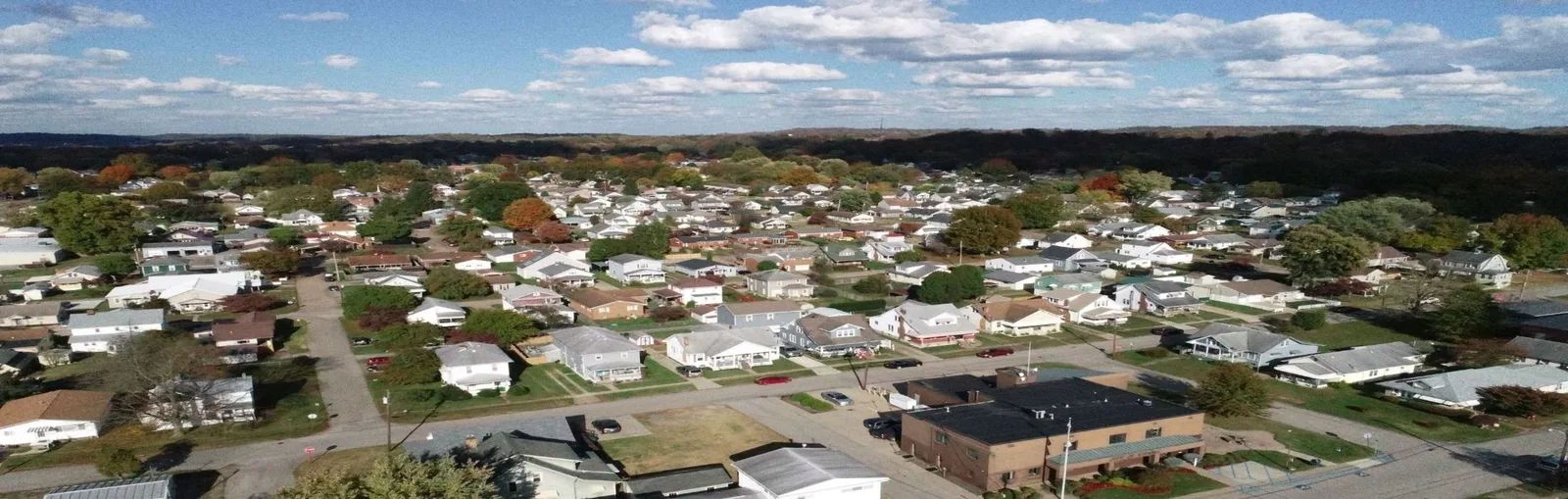
Crews cover the full county and the surrounding Mid-Ohio Valley, including river communities and outlying rural routes.
- Parkersburg - downtown historic district, Julia-Ann Square, South Parkersburg, and the Avery Street corridor
- Vienna - Grand Central Avenue neighborhoods and riverfront residential streets
- Williamstown - older brick and frame homes near the Ohio River bridge
- Mineral Wells and Lubeck - newer subdivisions on rolling terrain
- Boaz, Waverly, Walker, Rockport, and Davisville - rural properties on well and septic systems
- Blennerhassett, Washington, and Deerwalk - bottomland and terrace properties near the river
Service extends into neighboring Wirt, Ritchie, Pleasants, and Jackson counties, along with Belpre and Marietta across the Ohio line. Response teams stage locally so travel time stays short when multiple calls land during a single storm system.
Seasonal Damage Patterns in Wood County
Each season brings a different mix of emergencies, and knowing the pattern helps homeowners prepare before the call becomes urgent.
- December through February - frozen and burst supply lines in crawl spaces and unheated garages; wood stove and chimney fires peak; furnace puff-backs spread soot through duct systems
- March through May - snowmelt plus spring rain drives the heaviest flooded basement volume; sewer surcharge and sump failures cluster during multi-day rain events
- June through August - humidity keeps indoor dew points high, and mold growth accelerates in basements and crawl spaces; lightning-related attic fires and severe thunderstorm roof damage
- September through November - clogged gutters and leaf-packed downspouts redirect water into foundations; first heating cycles ignite dust and creosote, producing smoke odor complaints
Sewage cleanup calls do not follow one season cleanly - root intrusion peaks in late summer and fall, while surcharge backups follow spring storms. Mold removal requests, meanwhile, often surface months after the original water event, typically when a homeowner lists a property or notices allergy symptoms worsening indoors.
Housing Characteristics & Restoration Considerations
Wood County housing skews older than the national average, with large concentrations of pre-1960 construction in Parkersburg, Vienna, and Williamstown. That age profile changes how restoration is approached.
What we encounter in local homes
- Plaster over wood lath - holds moisture longer than drywall and requires injection drying or careful selective removal rather than blanket demolition
- Stone and unreinforced block foundations - porous, prone to lateral seepage, and difficult to seal without addressing exterior grading
- Balloon-framed walls - create vertical chases that carry smoke, heat, and water between floors and into attics
- Knob-and-tube or early cloth-insulated wiring - a fire origin risk and a safety consideration during demolition
- Finished basements added decades after construction - often built with paper-faced drywall and organic carpet padding directly against damp block
- Pre-1978 paint and pre-1980 materials - lead-safe and asbestos-aware protocols govern how affected materials are cut, bagged, and hauled
How this shapes the work
- Moisture meters and thermal imaging locate wet cavities so intact plaster is preserved wherever possible
- Sewage cleanup in older basements usually requires removing porous finishes entirely, since contamination penetrates block and framing
- Smoke restoration includes sealing framing in balloon-framed cavities to stop odor from re-emerging
- Mold remediation pairs removal with source correction - grading, gutter extension, or vapor barriers - so the problem does not repeat
Environmental Conditions & Damage Implications
The Mid-Ohio Valley climate is humid continental, with warm muggy summers, cold damp winters, and roughly 40 inches of annual precipitation spread evenly across the year. That steady moisture load means structures rarely get a chance to fully dry out on their own.
Local conditions that drive damage
- Summer dew points in the upper 60s - basements and crawl spaces hover near saturation without mechanical dehumidification, giving mold everything it needs
- Valley inversions - cool air settles along the river corridor, trapping humidity and smoke odor inside homes for extended periods
- Clay-heavy and silty terrace soils - drain slowly, hold water against foundations, and expand and contract enough to open cracks in older footers
- High water table near the rivers - hydrostatic pressure pushes moisture through slab joints and block cores even without visible flooding
- Freeze-thaw cycling - repeated winter cycles widen mortar joints and foundation cracks year over year
- Regional industrial and highway particulates - combine with fire residue to complicate air quality after a smoke event
Practical implications
- Structural drying targets must account for elevated ambient humidity, not just wet material readings
- Post-fire air scrubbing runs longer when inversions limit natural ventilation
- Mold clearance testing carries more weight here because visual inspection alone misses hidden growth in damp block cavities
- Sewage-affected soils under slabs may need treatment, not just surface disinfection
Drying and Restoration Technology Built for Ohio Valley Conditions
Standard drying approaches designed for dry climates fall short along the Ohio River. When outdoor air already carries a high moisture load, opening windows and running box fans simply moves humid air around. Effective restoration here depends on closed-system drying and equipment matched to local conditions.
Equipment and methods in use
- Low-grain refrigerant dehumidifiers - pull moisture from air that conventional units cannot touch, which matters in humid basements
- Desiccant dehumidification - deployed for cold-weather losses and large commercial spaces where refrigerant units lose efficiency
- Thermal imaging and penetrating moisture meters - map the true extent of migration behind plaster, under hardwood, and inside wall cavities
- Injection drying systems and floor mat extraction - save hardwood and preserve historic plaster instead of tearing it out
- Truck-mounted extraction units - move high volumes of water from flooded basements quickly
- HEPA air scrubbers and negative air machines - control airborne spores and soot particulate during mold and fire work
- Hydroxyl generators and thermal fogging - neutralize smoke odor at the source rather than masking it
- Antimicrobial and enzymatic treatments - applied under Category 3 protocols after sewage losses
How a typical project moves
- Emergency response, safety assessment, and utility shutoff where needed
- Water extraction or debris and soot removal, plus board-up and tarping after fire
- Containment setup and controlled demolition of unsalvageable materials
- Structural drying with daily moisture readings logged for the insurance file
- Cleaning, deodorization, antimicrobial application, and content handling
- Verification testing, then rebuild - drywall, flooring, trim, cabinetry, and paint
Documented readings and photo records at each stage give Wood County homeowners a clear record for their carrier and confidence that the structure is genuinely dry before finishes go back in.