
Damage Restoration in Middleborough Center, MA
- Damage Restoration Services Overview
- Common Damage Restoration Issues in Middleborough Center, Massachusetts
- Neighborhoods We Serve in Middleborough Center
- Seasonal Damage Patterns in Middleborough Center
- Housing Characteristics & Restoration Considerations
- Environmental Conditions & Damage Implications
- Septic Systems, Sewer Backups, and Contaminated Water in Middleborough
Damage Restoration Services Overview
You come home from work on a February evening, open the basement door, and hear water running where no water should be. A supply line behind the washing machine let go hours ago, and the finished basement carpet is already saturated. Situations like this move fast in Middleborough Center - and the response needs to move faster.
RestoreNow coordinates emergency response and complete structural restoration for property owners across Middleborough and the surrounding Plymouth County communities. The full range of services includes:
- Water damage restoration - extraction, structural drying, moisture mapping, and rebuild after burst pipes, roof leaks, and appliance failures
- Flooded basement recovery - pump-out, dehumidification, and treatment of foundation walls and slab assemblies
- Sewage cleanup - contaminated water removal, disinfection, and safe disposal of porous materials
- Fire damage restoration - emergency board-up, debris removal, and full structural repair
- Smoke damage restoration - soot mitigation, odor neutralization, and contents cleaning
- Mold removal - containment, HEPA filtration, affected material removal, and moisture source correction
Acting quickly limits secondary damage, protects framing and insulation, and keeps a manageable loss from becoming a gut renovation.
Common Damage Restoration Issues in Middleborough Center, Massachusetts
Middleborough Center sits in a low-lying section of southeastern Massachusetts where sandy outwash soils, high seasonal water tables, and older housing stock combine to create predictable failure points.
Frequent Causes of Loss
- Nor'easters and winter storms - wind-driven rain forces water past roof flashing, siding seams, and window headers while saturated ground pushes into foundations
- Frozen and burst supply lines - uninsulated pipes in crawl spaces and unheated basement corners fail during January and February cold snaps
- Sump pump failure - a pump that cannot keep pace during snowmelt or heavy rain floods a basement within hours
- Municipal sewer backups and failing septic systems - saturated leach fields push wastewater back through floor drains and lower-level fixtures
- HVAC and appliance failures - condensate drain overflows, water heater ruptures, and washing machine hose breaks saturate subfloors and wall cavities before anyone notices
- Heating-season fires - wood stoves, chimney creosote buildup, and space heaters drive winter fire and smoke losses
Warning Signs Worth Investigating
- Musty odors in basements or closets, especially after rain
- Cupping, staining, or soft spots in hardwood and laminate flooring
- Efflorescence - white powdery residue - on foundation walls
- Peeling paint, bubbling drywall, or discolored baseboards
- Persistent smoke or campfire odor that returns in humid weather after a small fire
- Gurgling drains or slow fixtures that point to a septic or sewer issue
Neighborhoods We Serve in Middleborough Center
Response covers the village center and the broader town, including outlying villages and neighboring communities throughout the Taunton River and Nemasket River watersheds.
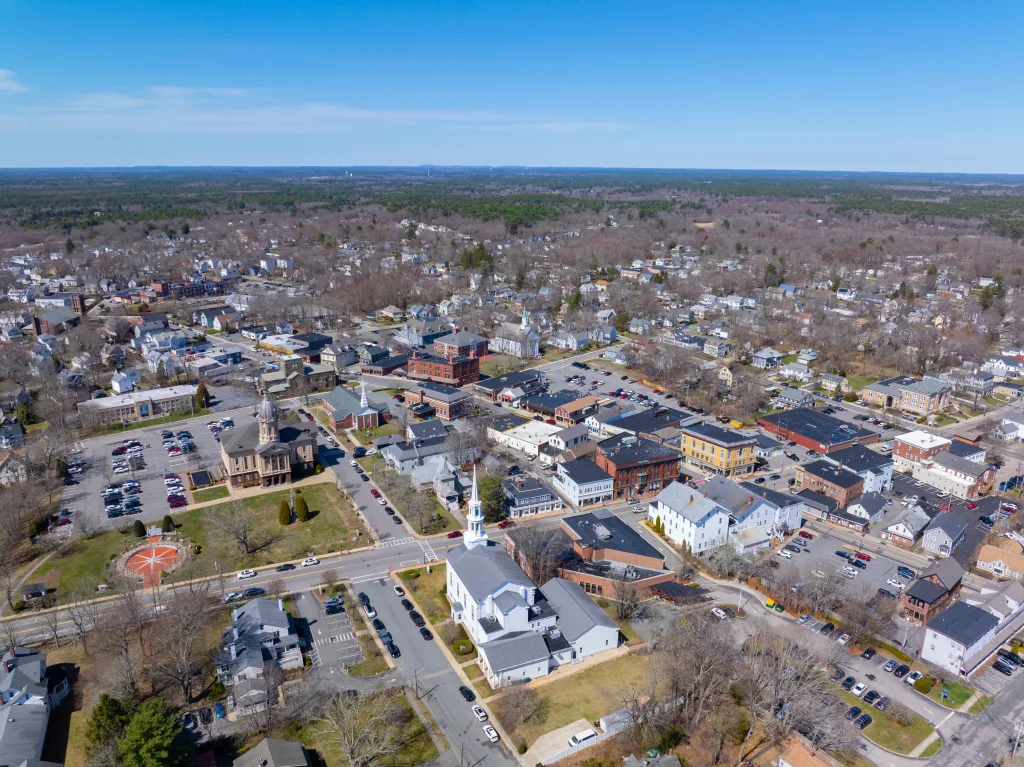
- Middleborough Center - the downtown core along Center, School, and North Main Streets, with dense older housing and mixed commercial buildings
- South Middleborough and Rock Village - rural properties on private wells and septic systems
- Waterville, Thomastown, and Eddyville - established residential pockets with varied foundation types
- Nemasket River and Assawompset Pond areas - homes with elevated groundwater exposure
- Route 105 and Route 28 corridors - residential and light commercial properties
Service also extends to Lakeville, Bridgewater, Carver, Halifax, Rochester, Raynham, and Plympton. Familiarity with local building patterns, municipal sewer coverage versus septic districts, and typical drainage behavior shortens the time between the first call and the first piece of drying equipment on site.
Seasonal Damage Patterns in Middleborough Center
- December through February - frozen pipe bursts peak during deep cold snaps. Ice dams back meltwater under shingles into second-floor ceilings. Heating equipment, chimneys, and holiday electrical loads drive the year's highest fire and smoke damage volume.
- March through May - snowmelt combined with spring rain raises the water table. Flooded basements, sump pump overload, and septic system surcharging peak. Sewage cleanup calls rise as leach fields saturate.
- June through August - humid continental summer air slows drying and accelerates mold growth. Air conditioning condensate line clogs, hidden wall cavity moisture, and basement humidity generate most mold removal work.
- September through November - hurricane remnants and early nor'easters bring wind-driven rain intrusion, roof failures, and surge-driven basement flooding. Clogged gutters full of oak and maple leaves redirect roof runoff against foundations.
Damage patterns overlap. A November storm that soaks a wall cavity often surfaces as a mold problem the following July if drying was incomplete.
Housing Characteristics & Restoration Considerations
Middleborough's housing stock spans more than two centuries, and each era brings its own restoration challenges.
Common Construction Types
- Antique colonials and Federals (pre-1900) - fieldstone or rubble foundations, plaster-on-lath walls, balloon framing, and wide-plank floors. Balloon framing allows fire, smoke, and water to travel vertically between floors through uninterrupted stud bays.
- Victorians and farmhouses near the village center - multiple additions with mismatched foundations and drainage paths that complicate moisture tracing.
- Post-war capes and ranches - poured concrete or block foundations, often with finished basements added later without proper vapor control.
- Late-century and modern colonials - tighter building envelopes that hold moisture in wall assemblies once water gets behind the vapor barrier.
How Age Affects Restoration Work
- Horsehair plaster requires different drying strategies than drywall and is worth saving when possible
- Homes built before 1978 need lead-safe practices during demolition and rebuild
- Pre-1980 buildings may contain asbestos in pipe wrap, floor tile, and duct mastic - testing precedes cutting
- Stone and brick foundations wick groundwater continuously, so basement drying involves both extraction and long-term vapor management
- Older chimneys and flues contribute to smoke odor migration long after a fire is out
- Knob-and-tube or aging wiring found during fire restoration often triggers required electrical upgrades in the rebuild scope
Environmental Conditions & Damage Implications
Local geology and climate shape how quickly a structure dries and how likely secondary damage becomes.
Climate
- Humid continental pattern with warm, moisture-heavy summers and freeze-thaw winters
- Summer dew points regularly sit high enough that outdoor air cannot be used effectively for drying - closed drying systems with dehumidification are the standard approach
- Repeated freeze-thaw cycling opens cracks in foundation walls and masonry joints, creating new water entry points each spring
Soil and Groundwater
- Sandy and gravelly glacial outwash soils drain quickly but sit above a shallow water table in much of the town
- Pockets of clay and hardpan create perched water that pushes against footings during wet stretches
- Proximity to the Nemasket River, Assawompset Pond, and surrounding cranberry bogs keeps groundwater high seasonally
- High water tables reduce septic leach field capacity, raising the risk of sewage backups into lower levels
Air and Water Quality Effects
- Basement relative humidity above 60 percent supports mold colonization on framing, cardboard, and stored contents within days
- Private well water carries iron and mineral content that stains materials during flooding and complicates cleaning
- Smoke and soot particles settle into porous surfaces and reactivate as odor when summer humidity rises, which is why odor treatment continues after visible cleaning is done
Septic Systems, Sewer Backups, and Contaminated Water in Middleborough
A large share of Middleborough properties outside the village center rely on private septic systems, while downtown and select corridors connect to municipal sewer. Both arrangements produce contaminated water events - just for different reasons.
Why Backups Happen Here
- Leach fields lose absorption capacity when the seasonal water table rises in spring
- Aging tanks and distribution boxes crack or shift over decades
- Tree and shrub roots infiltrate distribution lines in older rural systems
- Heavy rain infiltrates municipal lines through cracked laterals, surcharging the system
- Sump discharge improperly tied into sanitary lines overwhelms capacity during storms
- Grease, wipes, and non-flushable products block laterals in older downtown buildings
How Sewage Cleanup Is Handled
- Isolate the affected area and shut down HVAC systems to prevent airborne contaminant spread
- Extract standing contaminated water with dedicated equipment that is not shared with clean-water losses
- Remove and dispose of porous materials - carpet, pad, saturated drywall, insulation, and particleboard - that cannot be reliably disinfected
- Clean and apply antimicrobial treatment to all remaining hard surfaces, including framing, slab, and foundation walls
- Install containment and negative air pressure with HEPA filtration during removal work
- Dry the structure to documented moisture targets before any rebuild begins
- Coordinate the reconstruction phase - flooring, drywall, trim, and finishes - so the space is returned complete
Reducing Future Risk
- Pump and inspect septic tanks on a regular schedule
- Install a backwater valve on the main lateral where grade allows
- Keep sump pumps on a battery or water-powered backup
- Direct downspouts and grading away from the leach field and foundation
- Avoid parking or heavy storage over leach field areas that compacts soil





